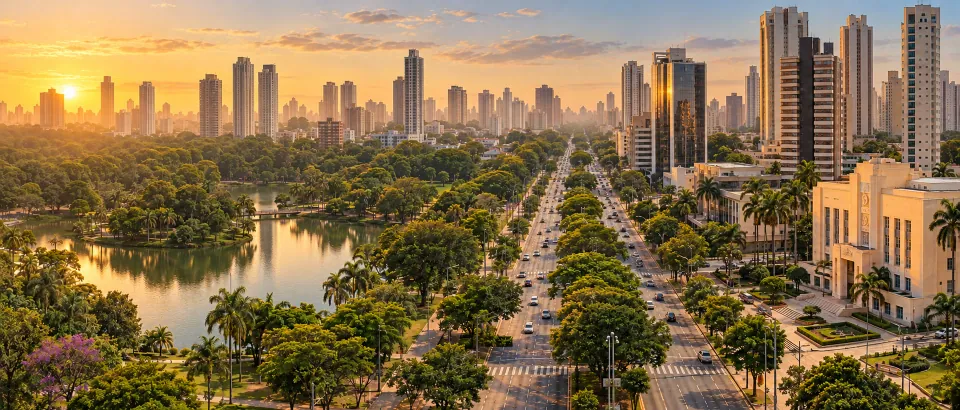














































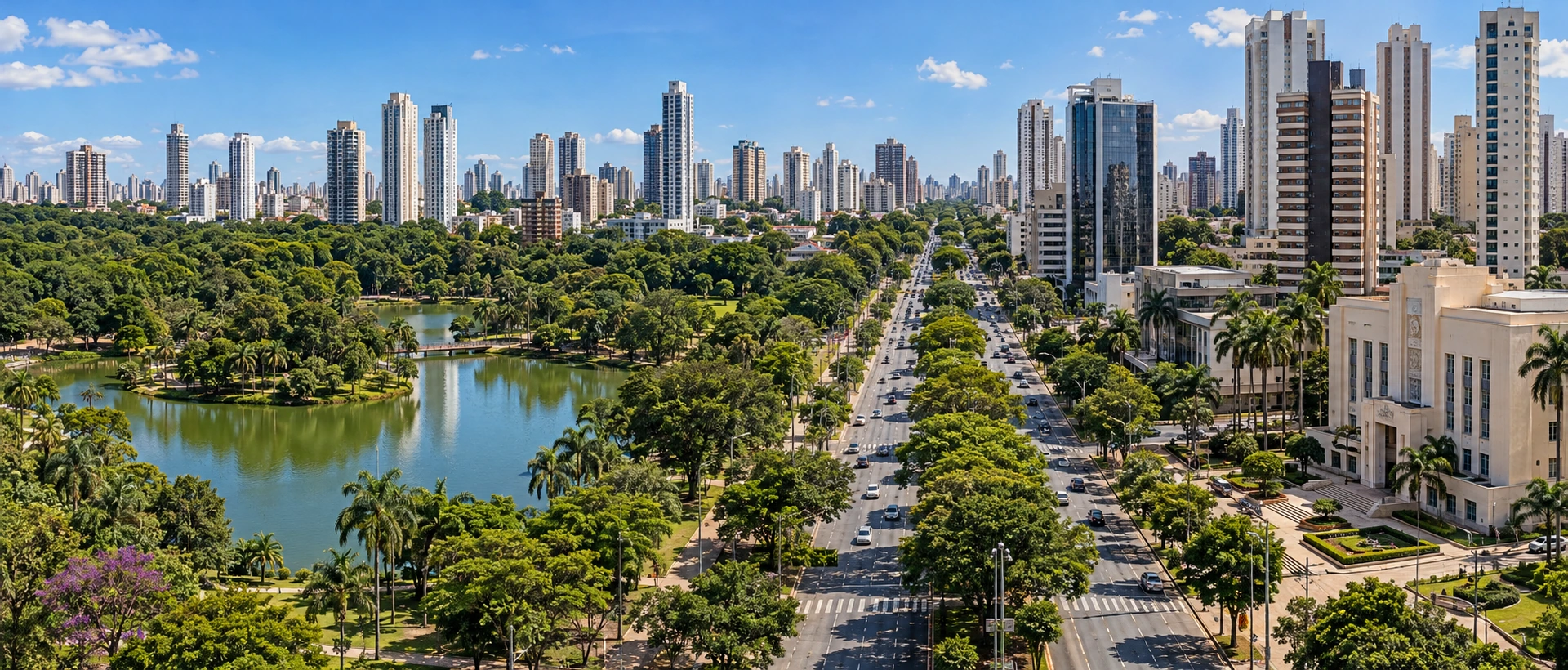
Goiânia has several urban parks, and business travelers can fit a walk into the time before or after work. Knowing the local time, however, is not enough to tell whether a trail will be bright, whether the lakeside will be shaded, or whether you can finish the return trip in daylight. Sunrise and sunset data provide a time reference, while a practical outing also needs to account for transport, weather, and the walking pace of your companions. This guide explains how to check daylight information for Goiânia and turn the figures into an adjustable walking plan, using urban parks such as Vaca Brava and Flamboyant as examples.
Choose the right city and date
Set the search page to Goiânia in the Brazilian state of Goiás; the city is also displayed as Goiânia. Confirm the location first, then select the date of your planned walk and check that the time is shown in the destination’s local time. If the page defaults to today but you plan to go out several days later, change the date and reload the figures. Confirm the city’s local time on the CityTimeDate Goiânia city page, then use the Goiânia sunrise and sunset lookup so the two kinds of information do not get mixed up.
When saving your plans, record the date along with the data rather than copying only a sunset time. The figures change from day to day, and an old screenshot will not update for the date you go out. If a friend uses another lookup tool, first check that you are using the same place, date, and time zone before discussing any differences. You do not need to memorize the daylight pattern for the whole year. Simply make a habit of checking again before each outing, rather than relying on a fixed month or a particular event.
Distinguish sunrise, sunset, and actual light
Sunrise and sunset are moments calculated according to astronomical definitions; they do not mean that every street or lakeshore has the same light at that moment. Nearby buildings, tree canopies, and your position can block the view, so a city lookup’s sunrise time does not guarantee that you will see the sun from the park entrance. If your main goal is a walk rather than watching the sun, use the figures as a reference for planning a daytime activity, then adjust for how bright it actually is and for the condition of the path. For the difference between sunrise, sunset, and twilight, see the U.S. Naval Observatory’s definitions.
Some tools also show day length or twilight periods. Day length can help you understand roughly how long the sun is above the horizon, but it cannot tell you directly how much shade a path has, how warm it feels, or how good the lighting is. There may still be natural light after sunset, but that does not mean every section is suitable for continuing on foot. If you are unfamiliar with the entrances, exits, and return route, it is more practical to finish the main part of the walk early and treat sunset as a reference point that calls for extra time—not as the moment to begin heading back.
Plan a walk around the park’s location
The Goiânia municipal tourism information lists Vaca Brava Park in the Bueno district and Flamboyant Park in Jardim Goiás. They are in different parts of the city, so consider where your accommodation or meeting is before deciding which park is easier to reach. If you only have a short break, there is no need to add cross-city travel just to fit several parks into one day. Choosing one place where you can clearly identify the entrance and pickup point usually makes it easier to control the length of your walk. Check the locations in the municipal tourism route information.
Before arriving, choose a meeting point and turnaround point, and estimate the trip to the park separately from the walk inside it. Waiting to cross city streets, finding the entrance, and waiting for a ride all use time that could otherwise be spent in daylight. If you do not know the paths, start with a section that is easy to retrace instead of setting out on a full loop right away. Light may differ along the lakeshore, under trees, and on open paths; adjust as you observe the conditions. Do not assume that the lighting in an online photo is a fixed feature you will see every day.
Read daylight separately from the weather
An astronomical sunset time cannot tell you whether it will rain that day, and it does not replace a current weather forecast. Before setting out, check the destination’s forecast and local advisories separately, and include a sheltered place to rest or an early-return option in your plan. If clouds thicken, rain picks up, or visibility worsens on site, shorten the walk according to the actual conditions—even if sunset is still some time away. The goal is not to chase a perfect sky, but to let the plan adapt when conditions change.
In strong sun, shorten uninterrupted stretches of walking and include shaded breaks and water. When the weather is unsettled, keep the park walk as a short segment you can cancel. Check the location and availability of rest facilities on site instead of assuming they can be used just because a map shows an icon. If a companion feels tired or unwell, do not postpone a break just to finish the planned route. For a short stay, getting back smoothly to your hotel or next meeting is more useful than filling every free moment outdoors.
Leave enough time for the return and your companions
The return plan should include walking back to the meeting point, gathering your belongings, and waiting for a pickup—not just time on the trail. If you are with children, older adults, or someone using a stroller, allow for street crossings, finding smooth paths, and breaks along the way. Do not estimate your own time from someone else’s walking speed. Starting with a short stretch and extending it if conditions allow is easier to adjust than promising to complete a full loop from the outset. If the pickup point requires walking along an outer road, work out how to recognize it before setting off, rather than searching for your ride after the walk.
After a short walk, note which entrance was easy to find, which section worked for your companions, and whether the return took more time. These personal notes help with the next plan more than a single sunset time, but check the weather and daylight again for the new date. When visiting another Brazilian city, do not reuse Goiânia’s figures. Go back to the CityTimeDate city directory to choose the destination, and make checking the city, date, and on-site conditions part of your routine.
Further reading and sources
Event dates, opening hours, and transport services may change. Check official updates before you travel.