














































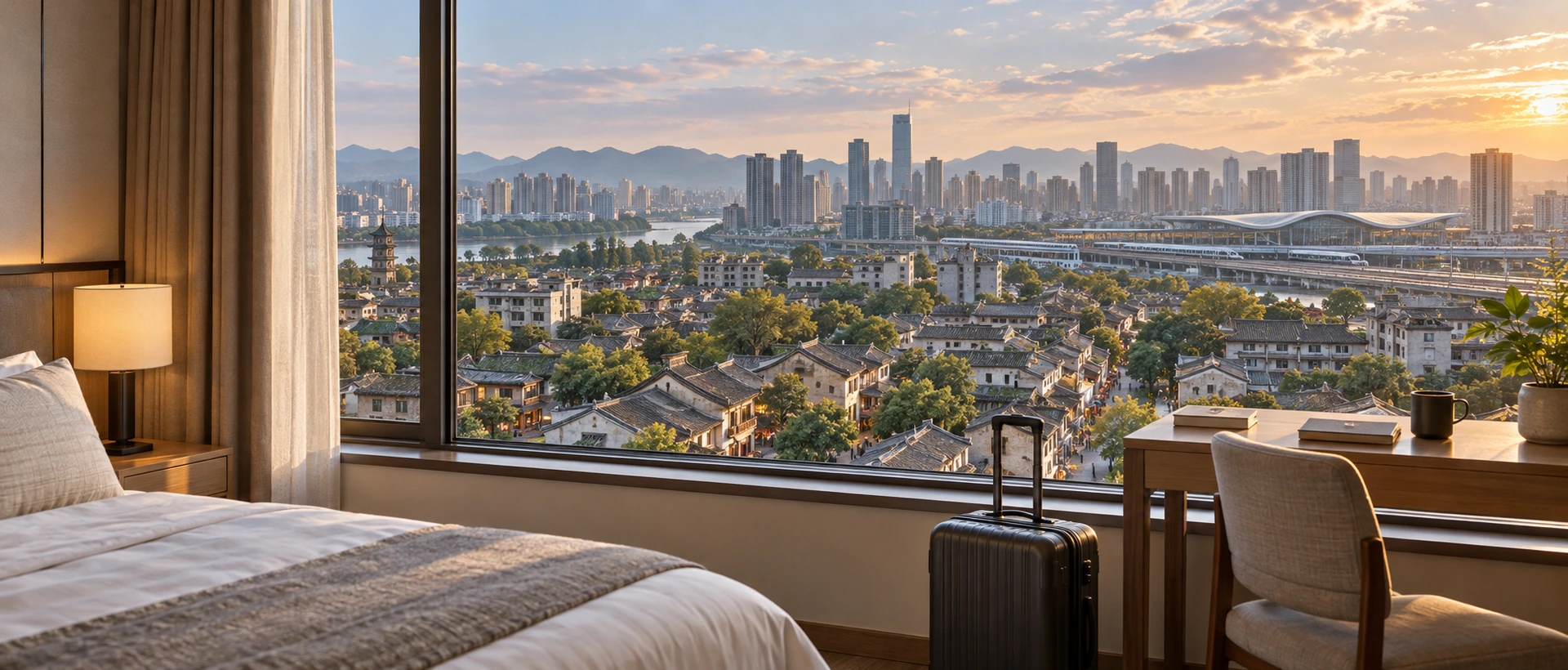
When choosing where to stay in Wenzhou, start by listing the actual addresses you need to reach each day rather than asking which district is better. A trip that includes walks through the old town around Wuma Street has different lodging needs from a short business trip that requires travel to and from Wenzhou South Railway Station. Companions’ walking ability, luggage, and arrival time can also change the tradeoffs. District names can narrow the search, but the final decision should be based on the hotel’s actual entrance and the complete route, then whether the price is worthwhile.
Choose a search area around the main purpose of the trip
Wuma Historic District in Lucheng can serve as a geographic reference for planning old-town walks; Wenzhou South Railway Station and the Panqiao area are reference points when comparing Ouhai lodging with rail travel. These names do not mean that an entire administrative district lies within one walkable area, nor do they guarantee that every hotel advertised as ‘near the old town’ or ‘near the South Station’ suits your route. Put attractions, meeting addresses, and the full railway station name shown on your booking in one record first, then see which accommodations reduce your actual travel back and forth.
The name of an administrative district cannot replace the lodging’s full address and actual entrance. When searching, keep the hotel name, street address, building, and usable entrance together; if needed, ask the property for pickup or walking directions. A map pin may fall in the middle of a building, and a sign seen from the road may not mark the check-in desk. If navigation directions differ from the property’s instructions, verify before setting out rather than repeatedly searching uncertain passages with your luggage.
Tradeoffs between old-town walks and rail travel
If your plans center on the lanes around Wuma Street, Chanjie, and Gongyuan Road, first compare lodging connected to those walking starting points. Open the route from the hotel entrance to the street corner you plan to visit and check whether you must cross a major road, go around to the other side, or take another ride. ‘Old-town lodging’ does not mean you can step out of the room and reach every attraction. Rain, heat, or traveling with children may also change how far you are willing to walk. Make the group’s acceptable way of getting around part of your location criteria.
If a business trip requires a train from Wenzhou South Railway Station, compare the complete routes between the station area and your meeting address before deciding whether to stay in Ouhai. Being near the station does not necessarily mean being near a client or office. A one-night stay after arriving late may call for a different location from several days of meetings in the city. Do not save one leg on arrival night while overlooking the daily trips that follow. If your rail booking names another station, compare again; do not assume every rail journey in Wenzhou starts at the South Station.
Compare room rates with total transport costs
Compare the lodging price and expected transport expenses together, using the same dates, room type, and number of guests. A lower room rate that requires more pickups or transfers may not reduce the cost of the whole trip; a higher rate does not automatically mean the location is suitable. Include the number of daily round trips, whether you will have luggage, and whether companions can travel separately. If a transport quote is only an estimate from the time you checked, note its time and conditions instead of treating it as the price that will necessarily apply when you arrive.
Estimate time for the complete route too, including waiting, finding entrances, walking, and checking in—not just time spent in a vehicle. For a departing train, allow time for entering the station, waiting, and ticket inspection, and check the cutoff for that specific service. This article gives no universal fixed travel time between Lucheng and Ouhai and makes no hotel promise about walking minutes to a station. Road conditions, actual start and end points, and travelers’ walking pace differ, so the right buffer differs too.
Check-in terms and room needs, item by item
Before booking, confirm with the property the actual number of guests, room type, bed type, documents needed for check-in, and expected arrival time. If you will arrive late, ask about that night’s reception arrangements and how to contact the property, and keep its explicit reply. Do not infer that someone will always be available to handle check-in from a general listing. If you need an elevator, step-free entrance, or a particular facility, describe how you will use it and confirm it is available. A facility photo on a webpage cannot replace confirmation for your booked room and the arrangements on your date.
Check noise, natural light, windows, and workspace for the specific room; do not infer them from the names Lucheng or Ouhai. Road-facing rooms, floor level, nearby construction, and room layout can all affect rest. Staying in the old town does not necessarily mean it will be noisy, and staying by the station does not guarantee quiet. If you need to join remote meetings, ask in advance about the internet connection and workspace, while preparing for an unstable connection. Separating requirements from preferences can help you avoid sacrificing what you actually need for an attractive promotional photo.
Arrival, departure, and backup plans for itinerary changes
Check the location first against the route on your arrival night and departure day, then see whether it works for the days in between. If considering a change of accommodation, also count checkout, moving luggage, waiting until the next room is ready, and finding the new entrance. Splitting your stay between two districts is not necessarily easier than staying in one place. Ask the actual service provider whether luggage storage, pickup, or early check-in is available and what it costs; do not treat these as automatically included after booking. If a train or meeting location changes, reassess using the new address.
Before paying, read the cancellation, modification, payment, and arrival terms for the selected booking, and keep a copy that identifies the room type and dates. Terms can differ by platform, rate plan, and date. Another rate being refundable does not mean your chosen booking can also be canceled free of charge. If your plans are uncertain, learn the actual cost of changes before weighing the room price. When a change is needed, use the contact channel stated in the booking; do not assume the property will waive fees or hold the room.
For coordination across locations, use the CityTimeDate Wenzhou city page to check the local date and time, and include Asia/Shanghai and UTC+8 in the itinerary so companions can identify the time zone. Before using the CityTimeDate timer to remind you to pack or prepare to check out, check your device battery, notification permissions, and sleep settings. A city clock and reminder cannot prove that a room is reserved or replace real-time notices from the property or carrier.
Save offline copies of the full address, entrance instructions, booking, and essential contact details, and note when they were last confirmed. On arrival, check the sign, building, and reception location before notifying companions to meet you. If the planned pickup point cannot be used for waiting, agree on another permitted place. Offline information can help identify the original plan but cannot prove that the entrance, reception, or transport service is still operating as before. Check for current messages once connected; if the accommodation changes, give the new address to everyone traveling with you.
Write each candidate stay as an itinerary you can actually follow: how to arrive, where you will go each day, how you will return to rest, and how you will leave on the final day. If you still cannot decide, return to the address or time slot that is hardest to change, secure that leg first, and then plan the walks. Lucheng and Ouhai are search directions; whether a particular property suits you still depends on the room, booking terms, and complete route. Knowing which conveniences you gain and which trips you add makes it possible to choose what fits this journey.
Further reading and sources
Event dates, opening hours, and transport services may change. Check official updates before you travel.