














































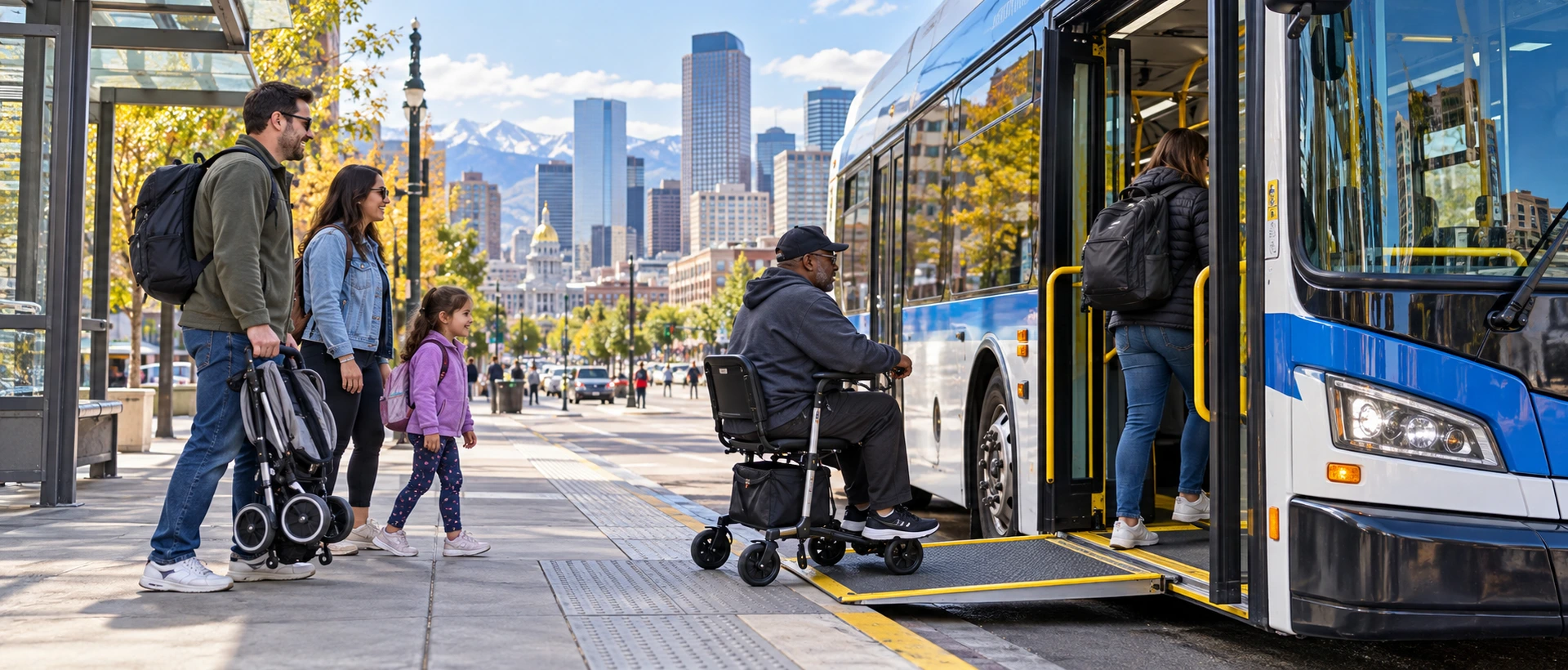
When planning Denver transit with a stroller, check three things first: whether you will use a bus, light rail, or commuter rail; whether the stroller must be folded under that service’s rules; and whether you will need an elevator or ramp to enter or move through the station. A map showing that a transfer is possible does not mean you can complete it in the same amount of time with a child, stroller, and luggage. It is more practical to include time to prepare for boarding and move through the station than to focus only on the shortest travel time.
Denver’s RTD operates several types of bus and rail services, each with its own entrances, vehicle layouts, and boarding rules that should be checked separately. Ordinary strollers for young children and mobility devices used because of a disability may also be subject to different rules, so do not assume one policy applies to both. Before leaving, check the local date and time on the CityTimeDate Denver page, then review RTD routes, stations, and service notices for your travel date. Leave enough time to complete your trip even if you miss one service.
Identify the service and stroller-folding rules
Write down the full names of your origin station, destination, route, and transfer points, then identify the type of service used for each leg. Commuter rail, such as the A Line, uses different vehicles from light rail. Do not assume that all trains have identical doors, step heights, or luggage space just because they are trains. Start with the relevant section of the RTD bus and rail riding guide and check the rules that apply to your service.
Before you leave, practice folding the stroller. Check how many hands you need, whether you can carry it once folded, and whether you need to remove the infant carrier, shopping bags, or cup holder first. Do not hang every essential item from the stroller; you may have to hold your child, manage tickets, and remove several bags at the station. Keep tickets, your phone, and a few essentials somewhere easy to reach, and group the remaining belongings in a bag that is easy to move. This can simplify boarding.
If you are traveling with only one adult, first consider whether you can fold and carry the stroller while keeping the child safely attended to. If that would be difficult, reduce your luggage or choose a different way to travel. When several people are traveling together, decide in advance who will care for the child and who will handle the stroller and belongings. Choose based on what you can manage in practice; you do not need to copy another family’s experience on the same route.
Fold the stroller and organize belongings before boarding a bus
RTD’s general bus rules require strollers for young children to be folded before boarding; only folded strollers may be brought on board. Large items such as strollers and luggage should be placed behind the wheelchair securement and priority seating areas, with the aisle kept clear. Check the latest rules in the RTD bus riding guide. Do not assume that a child can ride in an unfolded stroller on a regular bus.
Different conditions may apply to passengers who use a stroller because of a disability. RTD’s accessible bus information describes relevant exceptions and equipment. If this applies to you, confirm your device and any assistance arrangements with the operator before setting out. A family stroller does not automatically qualify for the same exception just because folding it is inconvenient. Follow the applicable rules for accessibility equipment or priority space, and tell the driver what assistance you need.
At the stop, find a place away from traffic where you will not block pedestrians, then organize your belongings. After taking the child out of the stroller, make sure an adult is caring for them before folding the stroller and preparing tickets. When the bus arrives, check the route and board and stow your belongings as the driver directs. If there is not enough suitable space, ask about arrangements and, if needed, wait for the next bus. Prepare to get off before your stop; once you have left the vehicle and reached a safe place, unfold the stroller. Do not stop to manage it in the doorway.
Check the rail platform and onboard space separately
For a rail trip, first check the full route from the street to the platform, then check how to board from the platform. Stairs, ramps, elevators, and platform layouts can differ by station and service. A station photo alone does not tell you whether you can roll the stroller all the way onto the train. While waiting, keep your child and belongings behind the safety line. Approach the doors only after the train has stopped and follow signs or staff instructions. If you are unsure about a gap, step, or how to use equipment, ask a staff member before boarding.
The RTD commuter rail riding guide lists storage options for strollers, car seats, and luggage. Which space you can use depends on the size of your belongings and the vehicle layout. An item stored in the luggage area should be folded and stowed; that area is not a place for a child to ride in a stroller. Keep your child seated beside a parent or guardian while riding, and do not block aisles, doors, or space other passengers need.
For light rail, check the information for the specific service rather than assuming that every vehicle has the same storage options as commuter rail. After boarding, make sure your child, stroller, and bags are all settled before checking the next stop or taking photos. Before getting off, decide who will care for the child and who will handle the stroller. If the area by the doors is crowded, allow time to wait and communicate instead of assuming you can fold or unfold everything during a brief station stop.
Check elevators and station service notices before leaving
If your route depends on elevators, check the origin, transfer, and destination stations, and check them again for the return trip. RTD’s accessibility information says elevator outages are posted in service notices. “The station has an elevator” and “the elevator is available on my travel day” are two different things. Do not assume an elevator that worked in the morning will also be available when you return in the evening.
Check RTD service notices for route and station updates, then use the live alerts page to confirm detours, stop closures, and elevator information. If a page has connection problems, incomplete information, or details that conflict with what you see on site, confirm with staff or customer service. The absence of a notice is not a live guarantee that every piece of equipment is working, so still check signs when you arrive.
If the elevator you planned to use is out of service, first check whether an open ramp, another suitable entrance, or an alternative route is available. Do not push a stroller carrying a child onto stairs or attempt to carry it along an uncertain route. If there is no suitable way through, consider another station, a different mode of transport, or a shorter outing. Those options are easier to manage than a transfer plan with no time or alternatives.
Plan transfers around your child, luggage, and breaks
When traveling with a stroller, compare routes with fewer transfers. A slightly longer ride may mean fewer times folding the stroller, carrying your child, and finding an entrance. Transit hubs such as Union Station have different boarding areas, and sharing a station name does not mean the platform and bus stop are beside the same door. Check the station map and on-site signs for the next leg, then account for the time needed to use an elevator, cross a street, or wait for another service.
Transfer buffers should include getting off, organizing belongings, finding an elevator, waiting, and handling your child’s unexpected needs—not just the minutes shown by a navigation app. If missing one service would affect an important reservation, leave earlier or choose a route that does not depend on a tight connection. For meals, diaper changes, and rest, choose a place you have confirmed is open and suitable for a stop. Do not assume every station has family facilities or an available restroom.
If your group includes an older adult, a wheelchair user, or people who move at different speeds, choose a route everyone can complete. Wheelchair securement and priority areas must be available to passengers who need them under the applicable rules; do not assume you can use these spaces for an ordinary stroller or luggage. If several people are handling different belongings, agree on a clear meeting point. Do not let a caregiver and child be forced onto separate services because the doors are about to close.
Further reading and sources
Event dates, opening hours, and transport services may change. Check official updates before you travel.